
For years, artificial intelligence was presented mainly as a tool capable of answering questions, generating texts, or helping with specific tasks. However, the recent evolution of AI models points toward a new generation of systems: agents capable of executing complete processes, organizing information, creating documents, and taking on repetitive tasks that previously required hours of human work. Within this trend appears Claude Cowork, a new proposal from Anthropic that seeks to turn artificial intelligence into a digital collaborator capable of actively participating in workflows.
The arrival of Claude Cowork on mobile phones and web platforms represents an important change in the way users interact with this type of technology. The tool, which was initially available as a desktop application, now allows processes to be started from different devices and work to continue even if the computer where the task began remains turned off. This feature reflects a transition from traditional assistants toward systems that can handle more complex activities autonomously.
More than simply responding to individual messages, Claude Cowork is designed to receive general objectives and develop a series of steps until completing a task. A user can request the creation of a report, the organization of data, the preparation of business documents, or the analysis of scattered information, and artificial intelligence can take responsibility for structuring the process. The central idea is that the person stops controlling every small action and moves toward supervising results.
From conversational assistant to digital work partner
The development of Claude Cowork is part of a broader trend within the technology sector: the creation of artificial intelligence agents. Unlike traditional chatbots, which generally wait for a question and provide an answer, Claude Cowork belongs to a new generation of agent-based tools capable of acting with greater independence. Claude Cowork can divide a complex task into several stages, use available tools, and produce concrete results in different work processes.
This difference changes the relationship between people and technology. With Claude Cowork, instead of asking an AI how to do something, the user can directly delegate a mission to it and allow Claude Cowork to develop the necessary steps to achieve an objective. For example, a company could request that Claude Cowork prepare a monthly report by combining sales data, internal documents, and observations from different departments. Claude Cowork can organize the information, generate an initial structure, and prepare a document for later human review.
Anthropic developed Claude Cowork using as a reference the architecture used in Claude Code, a tool originally focused on programming. The company observed that many capabilities created for developers could be adapted to other professionals who work with information, documents, and administrative processes. In this way, Claude Cowork expanded the concept of AI assistance toward more general activities within companies and work teams.
This change is relevant because Claude Cowork expands the reach of artificial intelligence beyond the software world. Although programming was for a long time one of the main fields where the potential of generative AI stood out, Claude Cowork usage data shows that an important portion of its applications is related to everyday business activities, such as document creation, information organization, and administrative task automation.
Creating reports, spreadsheets, and documents without starting from zero
One of the main functions highlighted in Claude Cowork is its ability to work with files and generate useful documents for different professional fields. Claude Cowork can help create spreadsheets, reports, presentations, and other materials based on instructions written in natural language, allowing users to explain what they need without having to master advanced technical tools.
This means that a person without advanced programming knowledge can request from Claude Cowork results that previously required managing several different applications. For example, a small business manager could ask Claude Cowork for an expense analysis, a supplier classification, or a basic income projection. A human resources professional could use Claude Cowork to organize employee information and prepare onboarding documents. A sales team could turn to Claude Cowork to convert scattered data into a presentation for clients.
The objective of Claude Cowork is not simply to produce automatic text, but to reduce the time dedicated to repetitive tasks. Many administrative jobs involve collecting information, copying data between documents, reviewing formats, and preparing preliminary versions. These activities consume a significant portion of the workday, although they do not always require complex decision-making.
Claude Cowork seeks to occupy precisely that space: taking care of the mechanical part of processes so that people can focus on analysis, strategy, and important decisions. In this way, Claude Cowork functions as support that allows daily work to be optimized and productivity to be improved.
The expansion to mobile: Working from anywhere
One of the most important changes announced by Anthropic is the arrival of Claude Cowork on mobile devices and the web. Previously, Claude Cowork’s capabilities were mainly linked to the desktop application. With this expansion, Claude Cowork allows users to start processes from a phone or browser and later access the results from different devices.
The possibility of continuing tasks in the cloud changes the traditional way of using productivity programs. For decades, files and processes depended on the computer where they were created. Now, Claude Cowork and other artificial intelligence agents propose a model where work can continue even when the user is not in front of the screen.
For example, a professional could start preparing a report with Claude Cowork before leaving a meeting and later review the result from their phone. A manager could request an analysis from Claude Cowork during a trip and receive a response when the document is ready for evaluation. This dynamic brings Claude Cowork closer to the concept of a permanent collaborator. It does not mean that Claude Cowork completely replaces a person, but rather that it can function as support available to accelerate processes, organize information, and facilitate the execution of professional tasks.
The mobile and web version of Claude Cowork began its rollout in beta for certain users, initially with subscribers of the Max plan, while Anthropic plans to progressively expand the availability of Claude Cowork to more users.
The real uses that are driving Claude Cowork adoption
Anthropic analyzed more than one million anonymous Claude Cowork sessions to understand how people use this technology in practice. The results show that the main use of Claude Cowork is not limited to programming, but includes multiple activities related to knowledge work. One of the most frequent categories corresponds to business operations. In this area, Claude Cowork is used for tasks such as consolidating updates from different teams, creating onboarding lists for new employees, and comparing information between different spreadsheets.
Another important area is content creation. Professionals in marketing, communication, and business use Claude Cowork to prepare drafts, proposals, presentations, and publications. Claude Cowork works as a fast first version that can later be reviewed, corrected, and improved by human specialists. Software development continues to be a relevant application for Claude Cowork, but it represents only one part of the ecosystem. The expansion of Claude Cowork into other sectors shows that generative artificial intelligence is no longer viewed only as a technical tool and is beginning to be incorporated into administrative, creative, and strategic activities.
The deepest transformation related to Claude Cowork is connected to the idea of delegating complete processes. For years, users learned to use specific programs: spreadsheets for numbers, word processors for reports, and presentation tools for slides. Claude Cowork proposes a different model: describing the expected result and allowing artificial intelligence to combine different capabilities to produce it.
A new relationship between humans and AI
The emergence of tools such as Claude Cowork represents a profound transformation in the relationship between people and digital systems. For decades, computing was based on programs where users had to learn a series of commands, menus, and procedures to obtain a result. With generative artificial intelligence, that logic begins to change: now, with Claude Cowork, a person can express an objective using natural language and allow the system to determine part of the path necessary to achieve it.
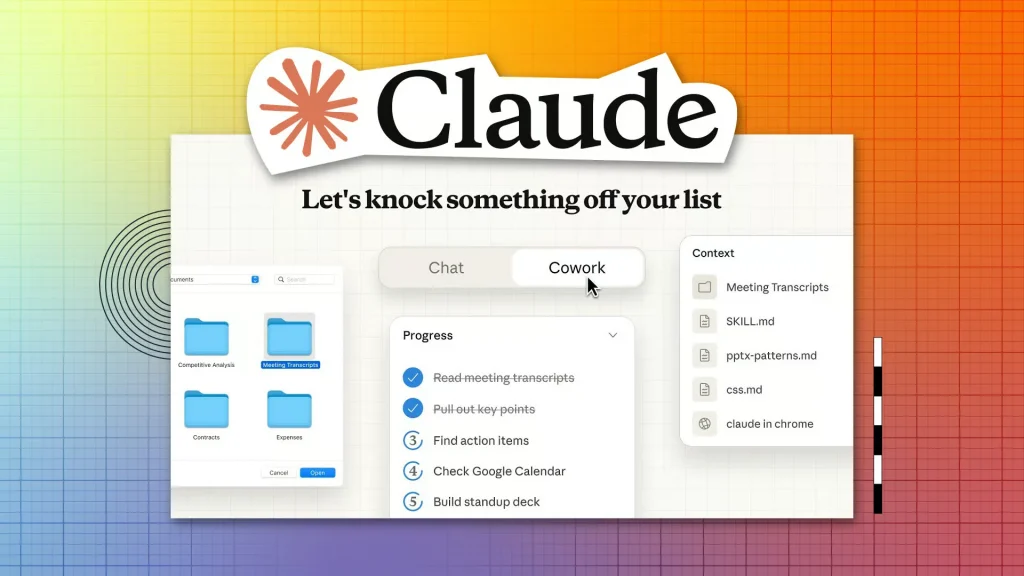
This evolution of Claude Cowork does not mean that artificial intelligence eliminates the need for human judgment. On the contrary, the more complex the tasks delegated to Claude Cowork become, the more important supervision becomes. A financial report, a business strategy, or a corporate document can be generated quickly through Claude Cowork, but they require review, context, and decisions that continue to depend on professionals.
Anthropic presents Claude Cowork as a digital collaborator, not as an automatic replacement for workers. The company argues that the main value of Claude Cowork and other artificial intelligence agents lies in reducing the time dedicated to operational tasks so that people can focus on higher-impact activities.
The difference between Claude Cowork and traditional assistants lies in the level of initiative. A conventional chatbot answers a specific question; Claude Cowork, by functioning as an artificial intelligence agent, can organize a sequence of actions and participate in broader processes. This capability turns Claude Cowork into a tool that is closer to an additional member of a work team.
The role of companies in the adoption of AI agents
The business environment is one of the main scenarios where Claude Cowork and other technologies based on AI agents are finding applications. Organizations generate large amounts of information every day: emails, contracts, reports, spreadsheets, recorded meetings, and internal documents. Processing all that material requires time and coordination between different departments. Claude Cowork attempts to solve part of this problem by allowing artificial intelligence to work with different connected sources of information. Claude Cowork can help gather data, organize documents, and prepare materials that can later be evaluated by employees and managers from each area.
An example would be a company that needs to prepare a quarterly review. Traditionally, a team would have to collect sales figures, review customer comments, compare results with previous periods, and prepare a presentation. With Claude Cowork, part of this process can be automated: Claude Cowork can organize the information, detect patterns, and generate a first draft of the report for later review.
Another possible case is the human resources area. Processes such as creating welcome documents for new employees, organizing internal policies, or summarizing evaluations can require many hours. Claude Cowork can speed up these tasks without managers having to start from scratch, allowing them to dedicate more time to strategic decisions related to personnel. However, the business adoption of Claude Cowork also requires establishing clear rules. Companies must define what information Claude Cowork can handle, which tasks require human approval, and how sensitive data used by the tool will be protected.
Privacy and security: The challenges of working with business information
The growth of artificial intelligence agents such as Claude Cowork also increases concerns related to privacy and security. Unlike a chatbot that only answers questions, Claude Cowork can interact with files, applications, and other digital resources. This expands Claude Cowork’s capabilities, but it also increases responsibility regarding how the technology is used. When a company allows Claude Cowork to access internal documents, it must consider aspects such as permissions, information storage, and access control. Not all data has the same level of sensitivity. A public marketing document does not represent the same risk as a confidential contract or a database containing personal information.
Anthropic has incorporated different control mechanisms into Claude Cowork. The company indicates that remote sessions allow tasks to continue from different devices, while some functions related to local files remain mainly associated with the desktop version of Claude Cowork. The existence of human supervision continues to be an essential element in the use of Claude Cowork. Although Claude Cowork and other AI agents may complete processes autonomously, final decisions involving important consequences must remain under the control of responsible individuals.
The challenge for companies will be finding a balance in the implementation of Claude Cowork: taking advantage of the speed and automation capabilities of artificial intelligence without losing the ability to critically evaluate its results, protect information, and maintain human involvement in the most important processes.
The importance of creativity and human judgment
Although Claude Cowork and other artificial intelligence agents can produce documents, analyses, and proposals in a short time, there is still a fundamental difference between generating information and deeply understanding a situation. Claude Cowork can process data, organize content, and create support materials, but the final interpretation of a complex problem still depends on people’s knowledge and experience. Human creativity, professional experience, and contextual knowledge remain difficult elements to replace. An artificial intelligence such as Claude Cowork can prepare a report about a company, summarize relevant information, or structure a proposal, but a person with years of experience in that sector can interpret details that do not always appear in the data analyzed by Claude Cowork.
For this reason, the model that appears to be gaining strength is not a competition between humans and artificial intelligence, but rather a collaboration between both. Claude Cowork provides speed, processing capability, and task automation, while humans provide judgment, objectives, creativity, and responsibility in decision-making. Claude Cowork represents precisely this vision: a tool designed to expand users’ capabilities and allow them to work in a more efficient way. The main function of Claude Cowork is not to completely replace human work, but to become support that facilitates the execution of processes and allows more time to be dedicated to activities requiring analysis and strategic thinking.
A look toward the next generation of digital tools
The evolution of Claude Cowork shows that artificial intelligence is entering a stage where the main question stops being “what can an AI answer?” and becomes “what tasks can an AI perform together with us?” Claude Cowork reflects this change because it is designed not only to answer queries, but also to participate in work processes through document creation, information organization, and task execution.
The incorporation of agents such as Claude Cowork, capable of creating documents, organizing information, and executing complete processes, marks an important transition within technological development. Mobile phones, the cloud, and advanced artificial intelligence models are converging to create tools such as Claude Cowork, available practically from anywhere and capable of supporting different professional activities.
Even so, the success of Claude Cowork and other similar tools will depend on factors that go beyond technology. User trust, data protection, system transparency, and organizations’ ability to adapt will be decisive in determining how these artificial intelligence agents will be integrated into the future of work. Claude Cowork is not only a new feature within Anthropic’s ecosystem. Claude Cowork represents an example of the broader change taking place in the technology industry.

The arrival of Claude Cowork represents an important step in the evolution of artificial intelligence applied to professional work. Beyond being a tool capable of generating documents or responding to instructions, Claude Cowork shows how AI agents are changing the way people organize their tasks, manage information, and develop complete processes. Its ability to create reports, structure data, automate repetitive activities, and collaborate in different areas makes Claude Cowork an example of how technology can be integrated to improve productivity.
However, the true value of Claude Cowork is not only in automation, but in the possibility of creating a new form of collaboration between people and intelligent systems. Artificial intelligence can provide speed, efficiency, and analytical capability, while professionals continue to contribute experience, creativity, judgment, and strategic decisions. The future of work will not depend only on having advanced tools such as Claude Cowork, but on knowing how to implement them correctly within organizations.
For companies, adopting solutions based on artificial intelligence requires planning, security, and an appropriate technological strategy. Integrating Claude Cowork efficiently involves analyzing internal processes, protecting information, and ensuring that the technology is aligned with business objectives. A correct implementation can become a competitive advantage by allowing teams to work in a more agile and efficient way.
In this new scenario, having a specialized technological ally is essential to take advantage of the full potential of artificial intelligence. ITD Consulting offers technological consulting services, digital transformation, and IT solution implementation to help organizations adapt to the new challenges of the digital environment. If your company wants to learn how to integrate technologies such as Claude Cowork, optimize its processes, or develop a personalized technological strategy, you can contact ITD Consulting by writing to [email protected].

 EN
EN  ES
ES