
In a move that promises to redefine the way we interact with technology inside our homes, Apple is preparing to launch an ambitious home ecosystem based on artificial intelligence (AI), robotics, and contextual personalization. The Cupertino-based company, Apple, known for its meticulous focus on design and user experience, plans to launch between 2026 and 2027 a family of devices aimed at consolidating its position in the smart home market—a field that has so far been led by rivals like Amazon and Google.
With a much deeper and more comprehensive approach than its previous efforts, this new Apple ecosystem will have at its core an intelligent desktop robot—currently in prototype phase—that will represent the union of sophisticated hardware, advanced artificial intelligence, and a complete redesign of home control software. Apple’s project is not merely an evolution of products like the HomePod; it is a complete transformation in the relationship between the user and their digital home environment.
Apple Enters the Smart Home Strong: Beyond HomeKit
For years, Apple has remained on the sidelines of the main battle in the connected home market. While it has offered solutions like HomeKit, integrations with Apple TV, HomePod, and growing compatibility with Matter, the unified standard for smart devices, the company never truly positioned itself as a major player in the sector. This was partly due to Siri’s rigidity compared to other assistants like Alexa, but also due to Apple’s limited variety of devices and a user experience that, while polished, didn’t offer a clear advantage over the competition.
Now, Apple seeks to correct that course with a strategy that not only competes in terms of functionality but offers an immersive, personalized, and much more proactive experience. According to journalist Mark Gurman, an expert in verified Apple leaks, the firm is internally developing a new home ecosystem in phases, which includes not only physical devices but its own operating system and a complete overhaul of its artificial intelligence.
This Apple project isn’t born from the idea of copying what Amazon does with Ring or Google with Nest, but from redefining the concept of the smart home, delivering what Apple does best: total hardware and software integration, minimalist aesthetics, and an extreme focus on user privacy.
Furthermore, Apple is betting on a long-term strategy, built on a modular foundation that will allow the progressive integration of new devices, services, and functionalities through software updates. This vision reinforces the idea that the home of the future will be a living, adaptable, and ever-evolving environment, capable of responding to the changing needs of its inhabitants.
The Desktop Robot: A New Device Category
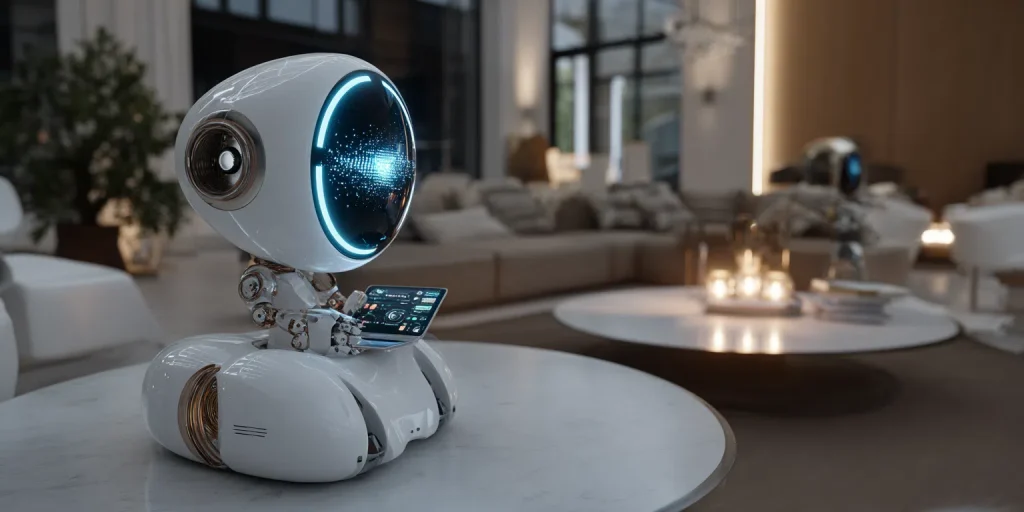
One of the most innovative elements of Apple’s upcoming ecosystem is a desktop robot that, according to internal descriptions, consists of a sort of iPad mounted on a robotic arm. It is not just a simple Apple control center but a device capable of visually and audibly interacting with users, following their movement, rotating its screen to face them directly, and acting as a true personal assistant.
This Apple robot will not only be equipped with facial recognition and voice tracking capabilities but will also integrate motion sensors, smart cameras, and a directional microphone that will allow it to recognize who is speaking and adapt its responses in real time. Additionally, its behavior will be powered by a redesigned version of Apple’s Siri, with support for next-generation language models that promise to adjust over time.
Its modular design will allow other peripherals to connect to the Apple robot, such as wireless charging stations, projectors, air quality sensors, and even accessibility tools for people with reduced mobility. The physical and digital customization capacity of this new Apple device will make it the epicenter of the smart home, capable of evolving over time with the user’s needs.
The functionality of this Apple robot will go beyond basic commands. It will be able to anticipate the user’s daily routines, offer contextual reminders (for example, suggesting a shopping list based on typical consumption), automatically organize video calls, play multimedia content based on each family member’s preferences, and even interact with other home devices.
This centerpiece symbolizes Apple’s turning point toward a new era, where devices not only respond but understand, adapt, and actively collaborate with people. This holistic perspective of the new device fits perfectly with the superior user experience that Apple has always focused on by integrating its systems seamlessly.
Siri 2.0: Artificial Intelligence Becomes the Domestic Brain
To make this new ecosystem truly intelligent, Apple has committed to reinventing Siri, its virtual assistant, which for over a decade has been criticized for its slow evolution. The new version of Apple’s Siri will not just be a voice assistant; it will be a cognitive platform powered by large language models (LLMs), enabling natural conversations, high-level contextual processing, and the ability to remember information from previous interactions.
This "new Siri" from Apple will debut first on iPhone and iPad starting with the iOS 26.4 update, scheduled for 2026. However, its most advanced and complex implementation will be reserved for the new home devices, where it will act as the operational center of Apple’s ecosystem. Siri will be able to make informed decisions, suggest changes to routines, act as an interface to control lights, temperature, security, and entertainment—and do so in a personalized way for each household member.
Apple’s AI will also be able to interact with users’ historical data, such as sleep habits, eating cycles, exercise routines, and daily commutes. Thanks to integration with Apple Health and other services, Siri will be able to recommend everything from healthy recipes to environmental adjustments in the home to improve the user’s overall well-being.
Apple is also working on a new graphical interface for Siri, with animated visual representations that respond to the user's emotions or needs. This visual evolution Apple is preparing aims to facilitate interaction for users of all ages, from children to older adults, and marks a new stage in the humanization of artificial intelligence.

Charismatic: The Operating System of the Home of the Future
To achieve a smooth and cohesive experience, Apple couldn’t rely on existing systems. For that reason, Apple has developed an entirely new operating system for its home devices: Charismatic. This software from Apple, still under development, is characterized by an interface based on widgets, contextual shortcuts, and visual elements similar to those of the Apple Watch, but designed for home control.
Its most prominent feature is the use of advanced facial recognition to adapt the experience to the user who is present. This will allow, for example, that upon entering the kitchen, a user will automatically see on-screen their daily agenda, the weather, and personalized reminders, while another family member could access completely different content.
Apple’s Charismatic will be prepared for multi-user environments, meaning that each person in the home will have a unique profile with independent preferences, history, and settings. Additionally, it will be able to integrate with proprietary apps from the Apple ecosystem, such as Calendar, Notes, Music, Maps, and more, thus extending the reach of the Apple experience to the physical home environment.
This innovative system from Apple will also include a layer of local machine learning—meaning it won’t need to send data to the cloud—which not only improves response speed but also reinforces Apple’s commitment to privacy.
This operating system from Apple is expected to control both the desktop robot and a fixed home display that Apple plans to launch in 2026. This display will serve as a home control panel, entertainment center, and also as a hub for video calls and important notifications.
Security, Video Surveillance, and Privacy: The New Battleground
Alongside these developments, Apple is also preparing its entry into the home security market. Although Apple has historically been very reserved with this type of device, it is now betting on a complete line of products that includes indoor and outdoor surveillance cameras, advanced motion sensors, and a smart doorbell with Face ID.
These Apple cameras will feature long-lasting batteries—up to a year on a single charge—infrared sensors for night vision, and the ability to automate actions based on facial recognition. For example, they could turn on lights when a family member enters a room or trigger an alarm if they detect the presence of a stranger.
Apple is also working on a “Pro” version with real-time computer vision capable of recognizing unusual behaviors (such as a fall, a violent argument, or suspicious repetitive movements), which could be vital in homes with elderly people or individuals with special needs.
Additionally, Apple plans to integrate these cameras with iCloud for secure recording storage, ensuring user privacy. Unlike other systems, such as Amazon’s Ring, which has faced criticism for sharing footage with third parties, Apple has remained consistent in its privacy policy—something that could position it as a safer option for consumers concerned about data misuse.
A digital peephole with facial unlocking is also being considered, which could connect directly to the Apple ecosystem and be controlled from the iPhone or the home robot. This reinforces the vision of a connected home not just in terms of comfort but also in protection.
The Challenge of Consolidating an Ecosystem: Can Apple Pull It Off?
Despite how promising this project sounds, Apple faces several challenges. On one hand, Apple must overcome market skepticism following previous efforts, such as the original HomePod, which failed to establish itself as the center of the smart home. On the other hand, Apple must compete against more open and affordable ecosystems like those of Amazon and Google, which enjoy greater global reach and more accessible prices.
Another major challenge for Apple is technical: integrating advanced artificial intelligence seamlessly and error-free into a domestic environment where the tolerance for failure is minimal. A robot that misinterprets commands, an assistant that fails to remember key information, or a camera that doesn’t function consistently could quickly undermine user trust.
There's also the matter of price. While Apple products stand out for their quality, they tend to be expensive, which could limit adoption in emerging markets or in households that have already invested in other platforms.
Finally, there’s the cultural challenge: not all users are ready to hand over control of their home to an AI. Trust is not built only with robust technology but also with transparency, accessibility, and an intuitive experience that doesn’t overwhelm or exclude.
Nonetheless, Apple has powerful cards in its favor: its closed and highly optimized ecosystem, its reputation for design and privacy, and a loyal user base that might be willing to invest in a more polished and coherent experience.

Apple’s push into the smart home market represents far more than a product line expansion: it is a strategic shift that redefines the way we understand the relationship between humans and technology in the domestic sphere. Apple is no longer content with offering connected devices; its goal is to create an integrated environment where hardware, software, and artificial intelligence work in synergy to anticipate needs, automate tasks, and discreetly and efficiently improve quality of life. This vision proposes a home that not only responds but actively collaborates with its inhabitants.
If Apple manages to implement this ecosystem in an integrated and seamless way, it will not only position itself as a strong competitor to Amazon and Google but could completely transform the rules of the game. Its focus on privacy, personalization, and user experience could set a new standard in the market, turning the home into a truly dynamic, adaptive, and people-centered space. Beyond technological dominance, this proposal aims to redefine everyday life—turning each interaction into a smooth, intuitive, and contextualized experience.
With the desktop robot as the symbol of this new era, Siri as the empowered cognitive core, Charismatic as the unifying operating system, and a home security line centered on trust, Apple is preparing to lead a quiet yet profound revolution. The home of the future is no longer a futuristic sci-fi vision; it is a reality in the making. And all signs point to that future, driven by Cupertino, beginning much sooner than we imagined.
If you want to learn more about the latest innovations that make life easier—like what’s coming from Apple—write to us at [email protected]. We have a team of tech experts ready to guide you and help you ride the wave of technological innovation.

 EN
EN  ES
ES